GTA – Encounters

Day 5

Today I walked alone yet had some interesting encounters.

The terrain was more agricultural.

Philippe took one look at me and recognised a like-minded hiker: light shoes and pack, equipped to be independent.

He had not got the memo and was walking south to north; most of us are going the other way.

His aim is performance and he has walked in 30 days what my book suggests takes 60 days.

We exchanged information about good bivouacs and restaurants, then got onto hard-core equipment issues. He even put up his super-light tent, one I have considered many times. Am I going to buy it …..

I do not know how long we talked, but it was fun.

On the other side of the pass I came to a road. Although it looked like nobody drove it, I decided to follow it and hitch-hike.

Angela gave me lift. We chatted between French and Italian. When we arrived at Varzo, I appreciated the ride all the more because it was a long way.

I went to Varzo only to get cash. Leaving was a challenge: no bus, no train, and no easy walk. Nobody offered me a lift either.

I walked along the road until it joined the main road. Suddenly I was in a bad place. This road was very narrow with barriers on both sides, lots of fast two-way traffic, and a tunnel ahead; walking it was not an option. Going backwards was not easy either.

A speeding small blue car pulled out of the stream and braked hard in front of me.

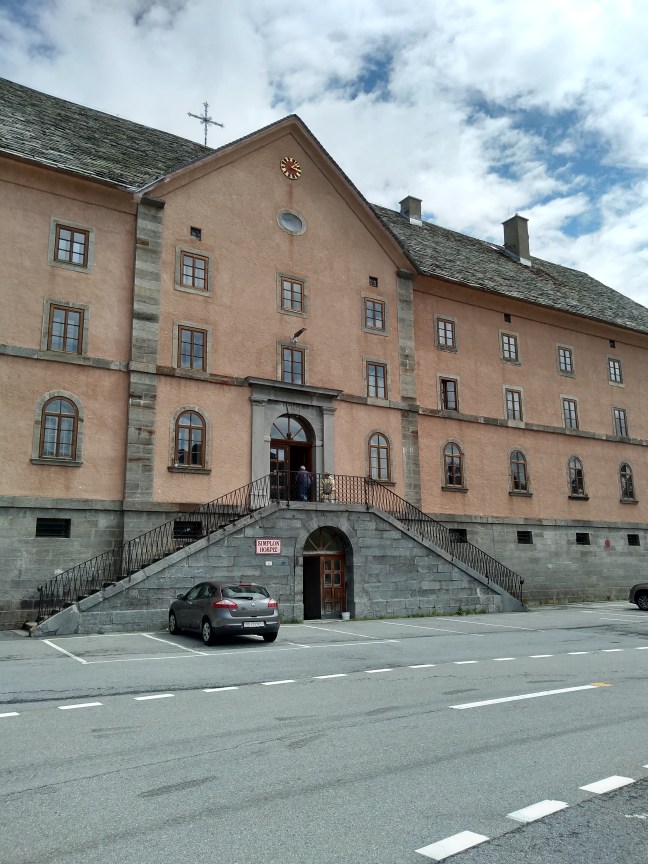
“I saw you were in a bad place and decided to give you a lift”, she said. We chatted easily and she drove me all the way to the Hospice de Simplon.

Where I ended up having a glass of wine and sharing stories with a senior Swiss politician (whom I had not recognised).

A good day for meeting people.

John

GTA – Alpe Devero to Alpe Veglia

Day 4

Leaving Alpe Devero I passed through a group of stone buildings and up a forest path. I came upon a flock of sheep with some goats mixed in. I watched the shepard lead his sheep to a spur; he whistled and they all followed.

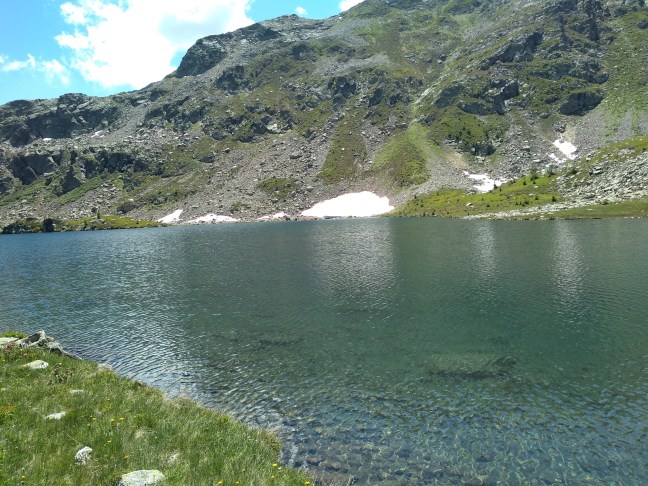
The path goes through a wide bassin that is soggy due to the late snow.

The first pass, Scatta d’ Orogna, had the tamest goats I have met: I turned for a photo but had to swing around and pull away a goat that wanted to eat my backpack.

After the descent, walking along the side of a lake in snow, I came to a critical point; I was with a couple of other hikers.

The original pass around the cliff face had been damaged by an avalanche in spring. A detour had been built, which meant a long climb down then back up over snow. Six Italians went along the original path and assured us it was safe enough.

We decided to follow them.

Parts of the path are not even; shards of rock bigger than me are scattered across it.

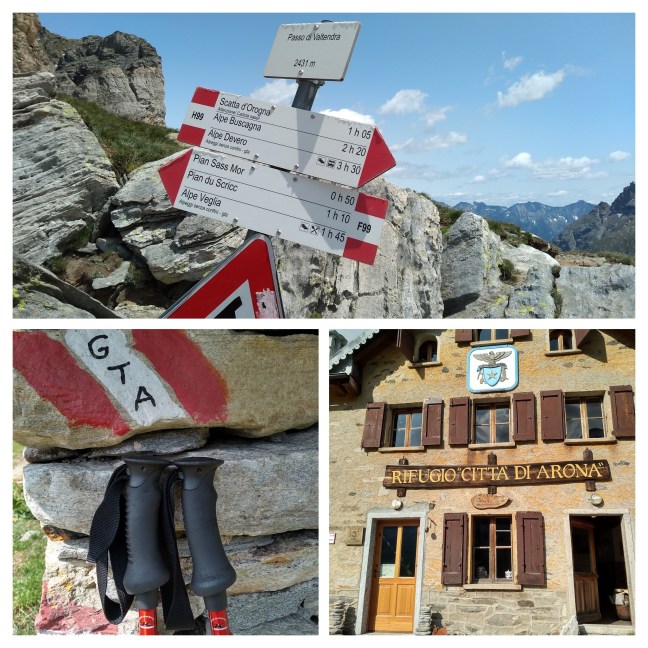
At the second pass, Passo Di Valtendra, we were hit by the wind. We retreated below the pass to take off our backpacks. A couple of minutes at the top for photos were enough.

Then I put on my wind jacket, gloves and beanie for the walk down the snow on the other side.

Beyond the snow it warmed up as I descended through a forest.

Alpe Veglia was the end-point, with a friendly refuge.

John

GTA – Rifugio Margaroli to Alpe Devero

Day 3

The refuge Margaroli, where I stayed, was very friendly. The food was good and I met a few people hiking the same route.

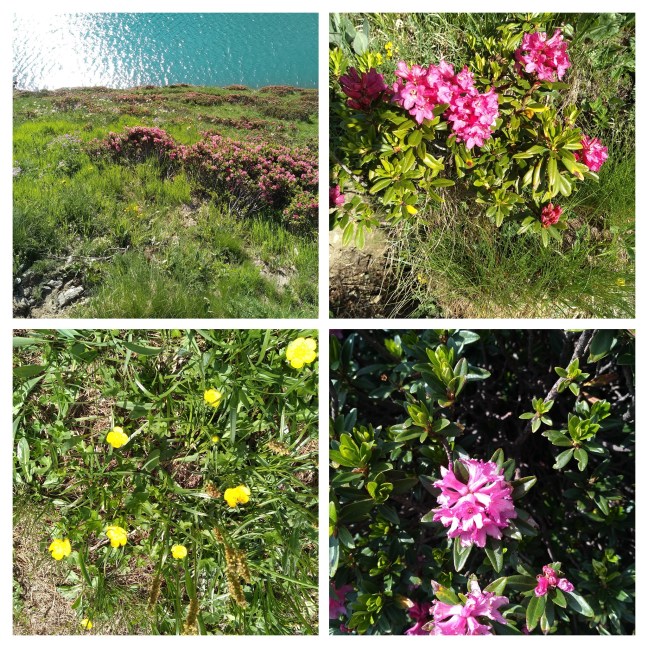
The path starts along a lake where many spring flowers are in bloom. I never tire of their beauty.

Maybe the long flat stretch allowed me to warm up, but the climb was easier, and I felt I hit my stride.

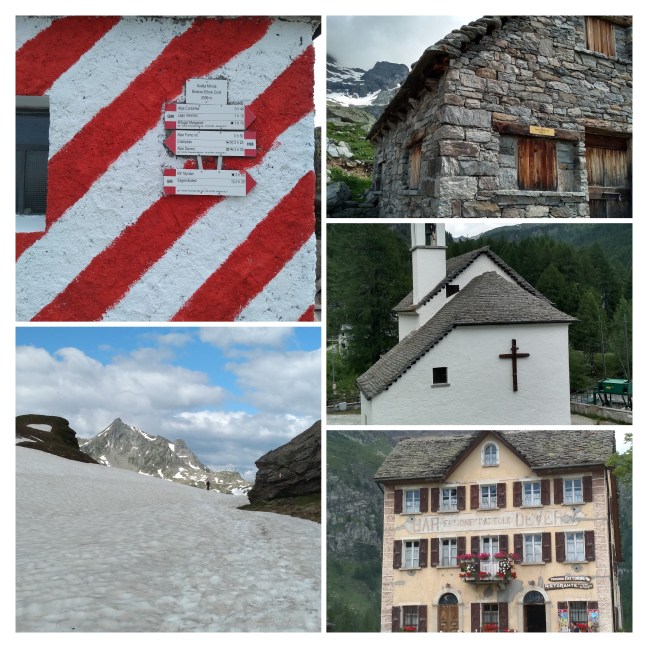
At the “Scatta Minoia” pass I met a group sheltering in a big hut, “Bivacco Ettore”. I have not seen many shelters at the top of a pass. Painted bright red and white it must be easy to see in fog.

We all started the long descent together but quickly spread. Snow still covers a lot of the pass.

The trail goes the length of lake Devero before reaching Crampionlo. The village has been renovated, renewing the stone_roofed buildings.

Alpe Devero is the end of today’s walk. It is larger and more spread out, with many beautiful stone buildings.

John

Grande Traversata Delle Alpi, GTA

Day 1

I had a late start from Cruina.

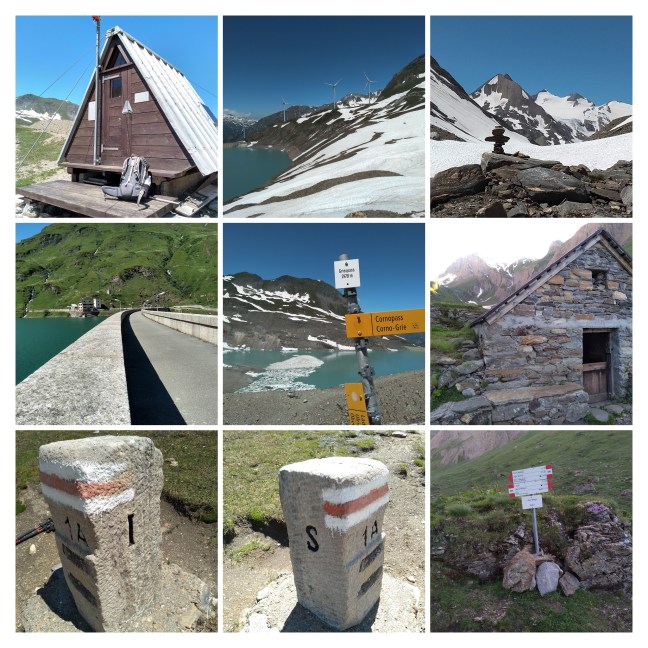
Leaving Geneva at 35° I was surprised by how much snow there is on the passes. Finding your way is harder, and slower.

We had hiked the Griespass a few years ago and were surprised by the aeolian. Now there are 4.

Just beyond the pass is a tiny chapel / shelter. In the early 50’s 9 scouts went hiking in perfect weather; 6 came back.

As adults, those 6 built the chapel in memory of their friends. Now it is well maintained.

I had expected to make it to the next refuge, but was behind schedule. Alpe Nefelgiù was a welcome sight. A stone hut with an elevated wooden platform to sleep on, shelter from the weather; luxury can take on different meanings.

I slept well.

A family wedding

We came back from Romania early July and went to the Haute-Marne department in northeastern France for Pauline and Fabrice’s wedding. Pauline is our niece.

A property, farm house and main building, had been rented and we could stay on the spot or in nearby bed and breakfasts. Fabrice is Belgian and friends and family had travelled from Belgium and Switzerland.

The wedding festivities started on Thursday with a cantus, the Belgian tradition of singing (many naughty) songs while drinking beer. The Belgian delegation came with a trailer of beer. On Friday evening, it was a raclette evening. The Swiss team had brought the cheeses, wines and grills.

On Saturday afternoon, the ceremony took place in the park of the domain, under the shade of old trees. It was a simple, moving and happy event. The rest of the afternoon was spent eating, chatting and playing games, followed by dinner in the barn.

Sunday morning saw all remaining guest having a brunch before driving back home.


Mariage dans la famille

Nous sommes rentrés de Roumanie au début du mois de juillet pour nous rendre en Haute-Marne, dans le nord-est de la France pour le mariage de Pauline et Fabrice. Pauline est notre nièce.

Une propriété, maison de maître et ferme, avait été louée pour l’occasion et l’on pouvait dormir sur place ou dans l’une des chambres d’hôtes de la région. Fabrice est Belge et les familles et de nombreux amis avaient fait le voyage de Suisse et de Belgique.

Les festivités ont commencé le jeudi avec le cantus, tradition belge de chants (un certain nombre coquins) en buvant de la bière. Ils étaient venus avec une remorque de bière. Le vendredi soir, place à une soirée raclette. La délégation suisse avait amené les fromages, les vins et les grills.

Le samedi après-midi la cérémonie a eu lieu dans le parc à l’ombre de vieux arbres. Ce fut simple, émouvant et joyeux.  Le reste de l’après-midi se passa en restauration, bavardages et jeux divers, suivi d’un souper dans la grange.

Les invités qui le souhaitaient pouvaient se réunir pour un brunch le dimanche matin avant de repartir à la maison.
Sighişoara and Sibiu

Peter and Sue were leaving for Australia on July 2 from Bucharest. So we had a few days available to visit Transylvania after our stay in Cluj-Napoca.

We travelled by train through green rolling hills and first stopped in the small town of Sighişoara. This village is the birthplace of Vlad III the Impaler, the inspiration for the character of Dracula. Its walled city is a World Heritage Site.


German influence is very present in these parts of Romania, architecturally as well as in German (and Hungarian) inscriptions on schools or on tombs. The station, like the city, has two sides with its dilapidated pylons on the platform and its brand new façade. Our Romanian trip ended in Sibiu (Hermannstadt) as we had to fly back to attend a wedding.

Peter et Sue repartait pour l’Australie le 2 juillet depuis Bucarest. Nous avions donc quelques jours de visites à disposition après notre séjour à Cluj-Napoca.

Nous avons voyagé en train à travers des paysages de collines verdoyantes et nous sommes d’abord arrêtés dans la petite ville de Sighişoara.

Ce bourg est le lieu de naissance de Vlad III l’Empaleur, inspiration du personnage de Dracula. Sa ville fortifiée est inscrite au patrimoine mondial de l’humanité. L’influence germanique est très présente tant dans l’architecture que dans les inscriptions en allemand sur les murs des écoles (avec le hongrois) ou sur les tombes. La gare, comme la ville a son côté pile et face avec ses pylônes délabrés sur le quai et sa façade flambant neuve.

Nous avons terminé notre court séjour en Roumanie à Sibiu car nous devions rentrer pour un mariage.

Happy birthday

As some of our family had to attend a wedding in Romania, we decided we would spend Jenny’s birthday there so we could turn it into a family event. We all met in Budapest and travelled by a really hot train to Cluj-Napoca, in Romania

It was fun spending the day together and finishing with a dinner full of conversations and laughters.


Une partie de la famille devant se rendre en Roumanie pour un mariage, nous avons décidé de nous y retrouver pour fêter l’anniversaire de Jenny en famille. Nos retrouvailles ont eu lieu à Budapest et nous avons pris un train étouffant pour Cluj-Napoca, en Roumanie.

Nous avons passé une belle journée ensemble et terminé par un dîner rempli de conversations et de rires.

A few days in Serbia

We had a few spare days before going on to Romania, so we took the train to go to Serbia, while Peter and Sue stayed in Budapest.

There is only one train per day to Serbia at the moment because a new, faster line is being built which will put Belgrade only 3.5 hours away from Budapest. As it is, it took us 7 hours (including about 45 minutes at the border, leaving Schengen, changing trains, all done in a relaxed manner) to reach Novi Sad.

Novi Sad, situated on the Danube, is Serbia’s second city, the capital of Vojvodina and a university town. Its city centre is very pleasant, with crowded terraces from late afternoon well into the night, and a very good daily market full of delicious, ripe, fruit and vegetables from the region, rich in agricultural products. Novi Sad will be one of Europe’s City of Culture in 2021.

The first photograph represents the last king of Serbia, Peter.

We saw these posters of high school graduates all over town and were told it is a local tradition, that they stay in place for 3-4 months and that students are not told of the location of their photographs. So, they go on a sort of treasure hunt…

20190625_165343.jpg

We then took a 1 1/4 hour bus ride to Belgrade, a much larger city with a very different feel. We strolled through some parks, the fortress, walked through different parts of town. A new neighbourhood is being built along the Danube, with skyscrapers. In fact, there are an amazing number of projects underway, from hospitals to apartment buildings.  The old central train station no longer sees  trains but the buffet is open and tickets can still be bought there.

20190628_142055.jpg

Quelques jours en Serbie

Nous avions quelques jours à disposition avant de partir en Roumanie et avons pris le train pour nous rendre en Serbie tandis que Peter et Sue restaient à Budapest.

Il n’y a qu’un seul train par jour pour la Serbie en ce moment car une nouvelle ligne est en construction qui mettra Belgrade à 3.5 heures de Budapest. Actuellement, nous avons pris 7 heures pour arriver à Novi Sad, dont environ 45 minutes à la frontière avec changement de train, contrôles pour quitter l’espace Schengen, le tout se passant facilement.

Novi Sad, située sur le Danube, est la deuxième ville du pays, capitale de la Voïvodine et un centre universitaire. La vieille ville est très plaisante avec ses terrasses bondées du milieu de l’après-midi jusque tard dans la nuit. Son marché quotidien regorge de magnifiques frruits et légumes mûrs de la région qui est riche en produits agricoles. Novi Sad sera l’une des “Capitale européenne de la Culture” en 2021.

La première photographie est un portrait du dernier roi, Pierre de Serbie.

Nous avons vu ces posters des étudiants ayant passé leur bac/matu dans toute la ville. On nous a dit qu’il s’agit d’une tradition locale, qu’ils restent en place de 3 à 4 mois et que les étudiants ne savent pas où se trouvera leur photo. A eux de partir à la chasse au trésor…

Nous nous sommes ensuite rendus en 1.15 de bus à Belgrade, une ville plus grande et à l’atmosphère différente. Nous nous sommes baladés dans ses parcs, la forteresse et différents quartiers. Les bords du Danube sont en chantier et plusieurs gratte-ciels sont en construction. En fait, un nombre incroyable de grands projets sont prévus, des hôpitaux aux logements. La vieille gare centrale ne voit plus de trains mais le buffet reste ouvert et on peut y acheter des billets.

Memento Park, Budapest

When Communism collapsed in Hungary in 1989, the city of Budapest was left with many public works of art that celebrated the Communist era.

The city government decided to save the statues rather than destroy them and the idea for the Memento Park was born.

On June 29th, 1993, the second anniversary of the withdrawal of the last Soviet soldier from Hungary, Memento Park was opened, in the outskirts of Budapest.

This park, full of statues and plaques commemorating the heroes of Communism, is almost a graveyard of sorts for that period of Hungarian history.


The boots belonged to a massive statue of Stalin that was torn down during the October 1956 Uprising, after which only the boots remained. The stand is a replica of where the party apparatchiks reviewed military parades.

John standing next to this figure gives an idea of the larger-than-life aspect of propaganda art. The original of this statue was damaged in the October 1956 Uprising only to be replaced two years later with this copy.


Built in 1956, the year of the uprising, this monument to the Hungarian-Soviet “friendship” is retrospectively ironic.

20190618_121354.jpg

Perhaps the most disturbing aspect of Memento Park is in the hut where a grainy black-and-white film is shown. It was a training film for the secret police which showed them how to spy on citizens. Many tricks used in spy movies were based on reality.
A la chute du communisme, en 1989, la ville de Budapest s’est retrouvée avec de nombreux ouvrages célébrant cette idéologie.

La ville a choisi de conserver ces statues plutôt que de les détruire et l’idée du Memento Park est née.

Le 29 juin 1993, deux ans jour pour jour après le départ du dernier soldat soviétique du territoire hongrois, ce musée à ciel ouvert a ouvert ses portes au sud de Buda.

Le parc abrite une quarantaine de statues et plaques commémorant les héros de l’ère communiste et semble presque être un cimetière dédié à cette période de l’histoire hongroise.

Ces bottes appartenaient à une statue massive de Staline, abattue lors de la révolution d’octobre 1956 mais dont les bottes restèrent en place. La plateforme sur laquelle se trouve cette statue est une copie de l’estrade d’où les apparatchiks regardaient les parades militaires.

John est photographié à côté de ces statues pour montrer leur gigantisme. L’original avait été endommagé lors de la révolution de 1956 mais avait été remplacé deux ans plus tard.

Construit en 1956, l’année de la révolution, ce monument à l’amitié soviéto-hongroise est rétrospectivement ironique.

L’aspect le plus dérangeant de Memento Park se trouve peut-être dans le pavillon de bois où un film noir et blanc est montré. Il était utilisé par la police secrète pour enseigner les méthodes de recrutement et d’espionnage des citoyens.