Linz

A rather dull and hot ride but the camping, offering no shade, was right next to a lake, so a dip was welcome.
Later, a 5km cycle to Linz, the city was crowded and festive because it was hosting its bi-annual street arts festival.

Une balade un peu ennuyeuse et chaude mais le camping, sans un brin d’ombre, était idéalement situé à côté d’un petit lac, un plongeon fut donc le bienvenu.
Un peu plus tard un tour à Linz, à 5km, la ville était en fête car leur festival des arts de rue, tenu tous les deux ans, en était à sa deuxième journée.

Berliner Höhenweg day five: Berliner Hütte to Griezer Hütte

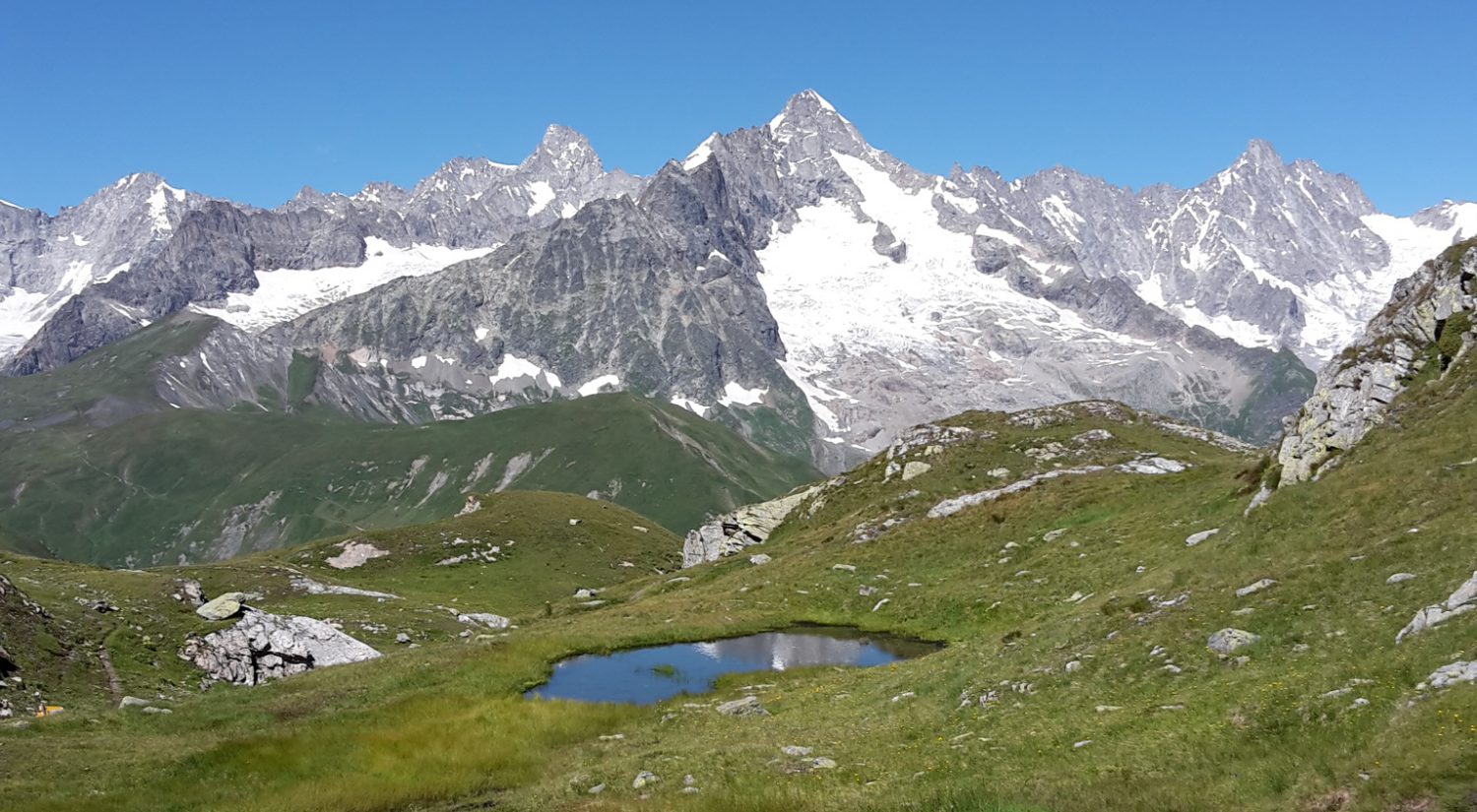
This was the toughest day.  Threatening weather meant an early start.  The climb to the pass was not too demanding, but we passed the beautiful, mirror-like Schwarz See.

The black clouds beyond the pass meant we should not wait at the top.  So I started my descent down the cliff face holding the cable. 

The rain started.

It was a steeper via ferrate than the previous day.  The rain made the cable cold and wet, and my fingers started to get numb.  I was scared.

My new-found friends, two families with four teenage girls, found it a giggle. 

So what a wimp am I? 

This hut was built by the Griezer section of the German Alpine Club.  A man working there played accordion in the evening.


First day in Austria

Entering Austria in the morning, the day was spent along quiet cycle paths, passing through natural reserves and using a first ferry for bicycles only, when the left side has no trail for a while.

Entrée en Autriche dans la matinée, la journée s’est passée le long de pistes cyclables tranquilles, à travers des réserves naturelles. J’ai pris un ferry pour vélo pour la première fois quand la rive gauche n’offre aucun sentier pendant quelques kilomètres.


Along the way were very tall (up to 2m) bushes with flowers that seemed to belong to the orchids family.

Il y avait de grandes plantes (jusqu’à 2m) dont les fleurs semblent appartenir à la famille des orchidées.


The river is wide enough for water-skiing, there were people kayaking, and the camping was, again, right along the edge of the water, at Kaiserhof.

Le fleuve est assez large pour permettre la pratique de ski nautique, j’ai passé des kayakeurs et le camping, à Kaiserhof, avait à nouveau les pieds dans l’eau.

Berliner Höhenweg day four: Furtschaglhaus to Berliner Hütte

This hike crosses a saddle.  From the saddle it is a short climb to the peak, the Schönbichler Horns at 3,134 m.  I left my pack at the saddle and climbed to the peak.

The view over the surrounding alps is beautiful as you are above most of the surrounding peaks.

The descent is somewhat tricky, and I learnt what “via ferrate” is in German: “Klettersteig”.

The Berliner Hütte was built by the Berlin section of the German Alpine Club in 1879 and is grandiose.  Early photos show it at the edge of a glacier, which is no longer there.


Passau and the three rivers

Every person I met in Regensburg said the same: take the train to get to Passau and start cycling from there. This is what I did and briefly visited the town, known as “the city of three rivers” because the Ilz and the Inn, which comes from the Swiss mountains, both join the Danube.

Toutes les personnes à qui j’ai parlé à Ratisbonne m’ont donné le même message : prenez le train jusqu’à Passau et pédalez depuis là. J’ai suivi leurs conseils et rapidement visité la “ville des trois rivières”. L’Ilz et l’Inn, qui prend sa source dans les montagnes suisses, joignent toutes deux le Danube à cet endroit.


The three rivers are all different in colours. The water in the Ilz is dark, almost black (no photo), the Danube is blue-brown but the Inn is much lighter, almost tending to silvery-grey. The simultaneous joining of the Ilz and the Inn create a new river twice the width of the old one. In fact, the river’s conjoining with the Inn creates headaches among hydrologists and geographers: for the Inn is clearly the wider of the two rivers and carries more water, and has travelled further to get here.

Les trois rivières sont de couleurs différentes. L’eau de l’Ilz est sombre, presque noire (pas de photo), le Danube est bleu-brun mais l’Inn est beaucoup plus claire, tirant vers le gris argenté. La jonction simultanée de l’Ilz et de l’Inn créée une nouvelle rivière, deux fois plus large que l’ancienne. En fait, l’arrivée de l’Inn pose des questions aux hydrologues et géographes car l’Inn est clairement plus large que le Danube, a un débit plus fort et a voyagé plus loin pour arriver ici.


After Passau, it was a short twenty-something cycle to a camping on the water’s edge, in Kohlbachmühl, still in Germany.

Le fleuve devient plus large et plus fort et je l’ai suivi pendant un peu plus d’une vingtaine de kilomètres avant de camper au bord de l’eau, dernière nuit sur sol allemand.


Anne and Lucien whom I met on the train to Passau and with whom I was to spend a lot of time with until Vienna.

20180803_102245

Anne et Lucien, que j’avais rencontré sur le train pour Passau et avec qui j’allais passer beaucoup de temps jusqu’à Vienne.
Regensburg, details in all shapes and forms

Doors, windows and other details, Regensburg

Ratisbonne, détails sous toutes les formes

Portes, fenêtres et autres détails, Ratisbonne

____________________________

In town, there is a Parisian-style French café, the Orphée. As I was passing by, I caught a glimpse of a poster in the corridor, on the side. This is what it says: “Orphée 40, Charles 94”

“Since the Orphée opened 40 years ago, the songs of Charles Aznavour have accompanied us in French and German. He enjoys a special veneration in this house.”

20180717_093738

En ville, il y a un café français de style parisien, l’Orphée. Comme je passais, j’ai aperçu un poster dans le corridor, par une porte latérale. Voici ce qu’il y est écrit : “Orphée 40, Charles 94”

“Depuis l’ouverture de l’Orphée, il y a 40 ans, les chansons de Charles Aznavour nous ont accompagnés en français et en allemand. Il bénéficie ici d’une vénération particulière.”

_______________________________

If you fancy going local, be warned, the complete outfit will set you back €700-2,000 (from head to toes). There is the cheaper option of checking the second-hand shops, where you can pick up bargains at around €60-80 a piece.

Si un costume national vous tente, sachez qu’il faudra y mettre le prix, ces Trachten et autres Dirndl vous coûteront de 700 à 2’000 euros (des pieds à la tête). Heureusement, il y a de nombreux magasins d’occasion où chaque pièce coûtera (tout de même) autour des 60-80 euros.

________________________

And, finally, the cover of Der Spiegel this week : “What it means for Germany to be the enemy of Donald Trump”

20180717_162654

Finalement, le Spiegel de la semaine : “Ce que cela signifie pour l’Allemagne d’être l’ennemi de Donald Trump”

Regensburg

Regensburg is a magnificent city with warm tones and a southern feel.
It was an important transition point on continental trade routes to Italy, Bohemia, Russia and Byzance.
It has been a real pleasure to stroll through its narrow streets and to see many different architectural styles form a very harmonious ensemble.

Ratisbonne est une ville magnifique aux tons chauds et à l’ambiance méditerranéenne.
Elle a été un point de passage important entre les routes commerciales continentales en direction de l’Italie, la Bohême, la Russie et Byzance.

Cela a été un vrai plaisir de déambuler dans ses ruelles et de voir des styles architecturaux différents former un tout harmonieux.


Berliner Höhenweg day two: Gamshütte to Friesenberghaus

This was to be a long nine hours hike, and the forecast was for storms in the afternoon.  Based on my first-day pace, I anticipated hiking ten hours.  Everyone left early.

All morning I walked through cloud and did not take my camera out.  The storms arrived and the rain and wind were cold.  During a break in the rain I put on my warmest clothes.

I use a stop-watch to keep track of time.  At seven hours hiking, expecting ten hours total, with the weather turning cold, wet and windy, I started looking for possible spots to shelter.  However there are few flat spots and it is all boulders and rocks.  Putting up a tent was not possible.

What a relief to see a sign indicating the hut was 30 minutes ahead.  I walked it in 8 1/4 hours.

I was put in one of the “winter” shelters.  These are left unlocked all winter for hikers and skiers.  There I met a young man from Colorado who is studying biology and thinking of becoming a vet.  Two days earlier I had been chatting with a young man from Ohio who is studying biology and thinking of becoming a vet.  The contrast between the two men was stark.


The Berliner Höhenweg, day one: Finkenberg to Gamshütte

On the train connecting the two paths, I chatted with a woman who spoke to me of the importance of ketones, the benefits of coconut oil and several other aspects of diet.  She was trim, healthy and 80.  I was surprised as I have been discovering these things over the past year; she is years ahead of me.  I was pleased to able to have such a conversation in German.

Leaving Finkenberg, you pass an old wooden bridge.  I also saw an old racing car someone had hauled from the Netherlands

The first day is an easy, though steep, three hours up to the Gämshütte.  I had been been keeping good time on the Adlerweg, but decided to go somewhat slower pace.  On the way about a dozen people all passed me in a hurry to get there.

The atmosphere was friendly and welcoming, more what I had been looking for.  The showers were outside with a stunning view and cold water.  (thanks Saval for introducing me to Wim)

I was glad to be above the tree-line.