Nara

We had not seen Hiroshi and Naoko for a long time, so it was a real pleasure to spend the day with them.
They drove us to Nara, stopping along the way to see some more cherry blossoms, where we had lunch and visited Todai-ji temple and Kasuga shrine.
Todai-ji hosts the largest bronze statue of Buddha in Japan.

Nous n’avions pas vu Hiroshi et Naoko depuis très longtemps, ce fut donc un plaisir de passer la journée en leur compagnie.
Ils nous ont conduits à Nara, avec un arrêt en route pour admirer d’autres cerisiers en fleurs, où nous avons déjeuné et visité le temple Todai-ji et un temple shinto, Kasuga.
Todai-ji abrite la plus grande statue de bronze de Buddha au Japon.


Kyoto

We managed to get one night in Kyoto. The city was packed with Chinese tourists who had hired kimonos from the tourist office (Osaka’s has 3’000 kimonos for rent, Kyoto would have many more). Others had photographers taking their (pre-) wedding pictures. There were also the thousands of day trippers.
The cherry blossoms were going to be at their peak this week-end and, although it was overcast, the rain was not due until Sunday afternoon.
Still, it was possible to find some tranquillity in lesser-known temples.

Nous avons pu trouver une chambre à Kyoto pour une nuit. Des milliers de touristes chinois avaient fait le déplacement et déambulaient vêtus de kimonos qu’ils avaient loués à l’office du tourisme (celui d’Osaka en a 3’000 à louer, Kyoto beaucoup plus). D’autres avaient engagé des photographes pour leurs photos de (pré-) mariage. Il y avait aussi de nombreux Japonais qui étaient venus pour la journée.
Les fleurs de cerisiers allaient atteindre leur apogée ce week-end et il n’allait pas pleuvoir avant dimanche après-midi, bien que le temps soit très nuageux.
Il nous a pourtant été possible d’éviter la foule en visitant des temples moins connus.


Before leaving Kyoto, we decided to go on a (shortish) hike, our first in Japan. We quickly left the crowds behind and were walking through forests, passed by temples (sake donations) and enjoyed a sushi picnic. Having reached the top of the hill, there were many groups of hikers and we met a lovely couple who very kindly invited us to go and stay with them.
We spent a wonderful evening in their company.

Avant de quitter Kyoto, nous avons décidé de faire une petite randonnée. Nous avons rapidement quitté la foule et marché dans la forêt en passant devant des temples isolés (avec dons de saké) avec pique-nique de sushis en route.
Arrivés au sommet, il y avait de nombreux randonneurs et nous avons sympathisé avec un couple qui a très gentiment offert de nous héberger.
Nous avons passé une excellente soirée en leur compagnie.

Osaka

We have arrived in Japan at the beginning of the spring holiday – and cherry blossom season, so it is almost impossible getting any accommodation.

Still, we had managed to book a night in a small hotel in Taishi, Osaka that only recently started receiving non-Japanese tourists.
The hotel is simple, very clean, offering individual rooms with tatami and futon (we added our sleeping mats for comfort), one toilet/floor, one shower for the hotel and a public bath (for men only) and really cheap. We liked it, extended our stay and spent some time exploring the little streets nearby.

We enjoyed seeing people cycling around the covered paved streets, had a drink in a small café, equivalent to an old bistro and admiring the Japanese’ talent to turn small daily things into works of art.


Nous sommes arrivés au Japon au début des vacances de printemps – et des cerisiers en fleurs – et il est quasiment impossible à trouver à se loger.

Pourtant, nous avons trouvé un petit hôtel à Osaka, dans le quartier de Taishi, qui a récemment commencé à héberger des étrangers.
L’hôtel est simple, très propre, offrant des chambres à une personne avec tatami et futon (nous avons utilisé nos matelats de camping pour plus de confort), toilette à l’étage, une douche pour l’hôtel et bain public (pour les hommes seulement). Nous l’avons trouvé très agréable et avons prolongé notre séjour; nous en avons profité pour explorer le quartier alentour.

Nous avons aimé voir les gens se déplacer à vélo dans les ruelles couvertes, se retrouver dans l’équivalent japonais du vieux bistrot du coin et admiré le talent des Japonais pour voir – et montrer – la beauté des choses du quotidien.

Shwedagon Pagoda

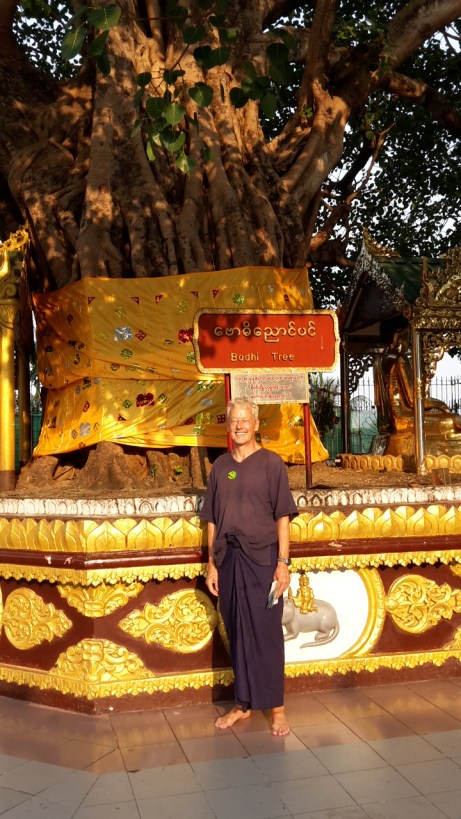
We visited Shwedagon pagoda in Yangon. John borrowed a longyi to meet the dress code.

20160228_165046

Nous avons visité la pagode Shwedagon à Yangon. John s’est habillé correctement pour l’occasion….

____________

Shwedagon Pagoda: about 588 BC two merchants offered Gauama Buddha alms-food. He blessed them by giving them eight strands of his hair. They returned to Myanmar and gave the eight hairs to the king, who had Shwedagon built to enshrine them.

The site has gone through many modifications and restorations.

Now, the main pagoda stands 99 m high and is covered with gold. There are many smaller shrines and pagodas, all ornately decorated. It is overwhelming.

As we watched, we saw the many visitors were predominately local or pilgrims and were there to worship. Although gorgeous, it is used and “lived in”, people laughing, children running.

So merchants aren’t always useless.


Pagode Shwedagon : 588 av. J.C., deux marchands donnèrent des offrandes alimentaires à Gauama Buddha. Il les bénit en leur offrant 8 cheveux. Ils retournèrent en Birmanie et remirent les cheveux au roi. Celui-ci fit alors construire la pagode pour les abriter.

Le lieu a subi plusieurs modifications et restaurations.

De nos jours, la pagode principale mesure 99m et est recouverte d’or. Il y a de nombreuses pagodes et temples autour, tous richement décorés, impressionnant.

Alors que nous nous promenions dans les lieux, nous avons remarqué que la grande majorité des visiteurs étaient des locaux ou des pélerins et étaient venus pour prier. Le tout dans la bonne humeur, en famille, avec les enfants qui couraient et en riant. C’est un lieu vivant.

Les marchands peuvent donc être utiles.

Street market in Yangon

We arrived in Yangon, Myanmar, last night and spent most of our first day strolling through the old town, soaking up the atmosphere and walking around street markets.
People are friendly, smiling and helpful and most of them still wear the traditional longyi, a piece of cloth similar to a sarong.


Marché à Yangon

Nous sommes arrivés à Yangon, Myanmar, hier soir. Nous avons passé notre première journée à déambuler dans la vieille ville et à travers les marchés.
Les gens sont souriants, aimables et accueillants. La plupart portent encore le longyi, proche du sarong.

Chinese New Year, Day 8

Monday, the 8th day of Chinese new year saw the biggest celebrations in Penang. The largest Chinese population group here is Hokkien and it is their first day of the new year.
We first went to the floating temple, then made our path through the crowds to Chew jetty.
A long table was covered with food offerings; the air was filled with smoke from the enormous joss sticks, firecrackers and fireworks.


Nouvel An Chinois, huitième jour

Lundi, 8e jour du nouvel an chinois a vu les plus grandes célébrations à Penang. La plus importante communauté chinoise ici est Hokkien et c’est leur premier jour du nouvel an.
Nous nous sommes d’abord rendus au temple flottant puis nous sommes frayés un chemin dans la foule pour arriver au ponton des Chew.
Une longue table était couverte d’offrandes de nourriture. L’air était rempli des fumées des énormes bâtons d’encens, des pétards et des feux d’artifices.

Luang Prabang

We left Vientiane for a bumpy and rainy ride to Vang Vieng; there are no trains in Laos. Stayed overnight, sleeping with our jackets and hoods on (in a hotel room, not camping, only 5 degrees, they did not have blankets). Another cold, bumpy and long ride, through fog, on mountain roads, and we finally reached Luang Prabang, 168 km and 7 hours from our previous stop. Caught the one hour sunshine yesterday.

Luang Prabang is located in the north of Laos and is an outstanding example of the fusion of traditional architecture and Lao urban structures with those built by the French colonial authorities.


Nous avons quitté Vientiane par mini-bus, sous la pluie et sur des routes cahoteuses pour Vang Vieng; il n’y a pas de trains au Laos. Nous avons dormi dans nos vestes, avec le capuchon (à l’hôtel, pas sous la tente), 5 degrés, pas de couverture. Une autre longue journée de voyage, dans le brouillard, et nous voilà arrivés à Luang Prabang, après 168 km et 7 heures. Nous avons pris ces photos pendant l’heure de soleil d’hier.

Luang Prabang est située au nord du Laos et reflète la fusion de l’architecture traditionnelle et des structures urbaines laotiennes avec celles des autorités coloniales françaises.