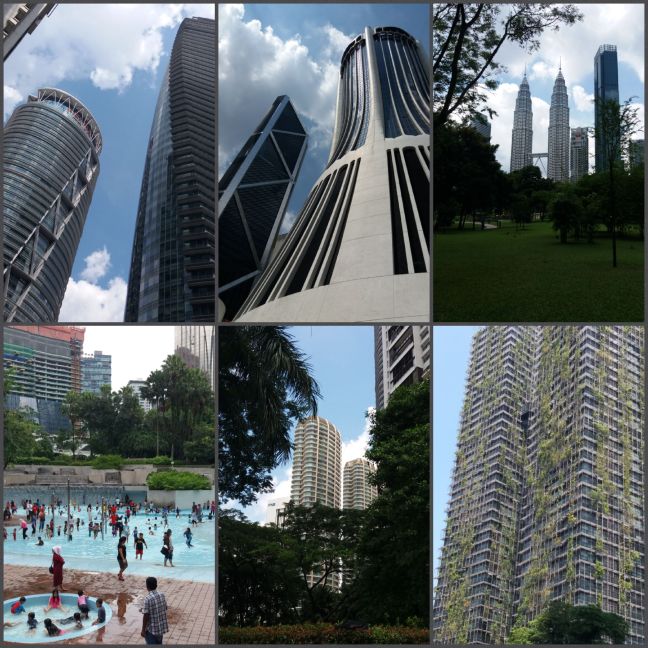
Rest and recovery in Kuala Lumpur

Our plan was to go to Vietnam after the Philippines but we had not counted with Têt, Vietnamese New Year.

In order to get a visa on arrival, one needs to apply online first, wait a few days to receive a letter of invitation, which will give the right to the visa when arriving.
The online services, and the embassies, were closed from 1-10 February (Têt) and visa applications would only start to be processed as of 11 February. How long it would take to be handed the precious sesame was unclear but with a backlog of 10 days, it might be long.

We had flown into Kuala Lumpur from Manila and booked a couple of nights in a pleasant hotel close to the twin Petronas towers. We had the pleasure of seeing again a former colleague of Jenny’s (and John’s occasional sailing mate) and his delightful family, who now live in and enjoy KL.

A couple of days later, Jenny came down with a cold, a cough and a fever (the boat to Manila and its freezing temperatures..). Three days later, no improvement, doctor: bronchitis and the beginning of a lung infection; it meant rest and medication.

The trip to Vietnam is no longer on the cards, since we will run out of time before our return to Geneva in early March.

20190214_095638

Repos et récupération à Kuala Lumpur

Nous pensions partir au Vietnam après les Philippines mais avions oublié Têt, le nouvel an vietnamien.
Pour pouvoir obtenir un visa à l’arrivée, il faut postuler en ligne, attendre quelques jours la réception d’une lettre d’invitation, à présenter en arrivant et recevoir le visa.
Les services en lignes et les ambassades allaient être fermées du 1er au 10 février pour le Têt. Avec les demandes accumulées sur dix jours, il n’était pas clair quand nous pourrions recevoir le précieux sésame.

Nous avions pris un vol pour KL et réserver deux nuits dans un hôtel agréable près du parc des tours Petronas. Nous avons eu le grand plaisir de retrouver un ancien collègue de Jenny (et co-équipier occasionnel de John) et sa délicieuse famille. Ils apprécient leur vie à KL.

Quelques jours plus tard, Jenny a eu de la toux, un rhume et de la fièvre (ce bateau glacial…). Trois jours plus tard, pas d’amélioration, visite chez le médecin: bronchite et début d’infection pulmonaire, donc repos et médicaments.

Le voyage au Vietnam ne se fera pas, nous n’aurions pas assez de temps avant notre retour à Genève au début mars.

Church 2.0

Dwindling church attendance has forced the clergy in much of Europe to confront the question of what to do with their churches, chapels and monasteries that have become redundant and require small fortunes to keep up

Disused churches can be found in northern Europe and many are simply closed; German churches are supported by tax revenues and French ones are municipal properties, all of which can help with maintenance costs.

In the Netherlands though, many churches have been sold and found a new life as cultural centres or mosques. More unusually, we have seen them transformed into apartments (in the centre of Utrecht), a bookshop, a student cafeteria and a hotel/restaurant/bar in Maastricht.

A temporary ice-skating rink was recently installed in a church in the small town of Gouda to keep the locals entertained until the more traditional skating rink circling the city hall opens today (photo from Gouda tourist office).

45308671_2161237374138094_5135004737075686461_n

La baisse de fréquentation des églises en Europe a forcé le clergé à se poser la question: que faire de ses églises, chapelles et monastères vides qui coûtent des fortunes à entretenir.

Beaucoup d’églises ne sont plus utilisées dans le nord de l’Europe et sont fermées; en Allemagne et en France, elles reçoivent des fonds publics (impôt ecclésiastique) ce qui couvrent une partie de leur entretien.

Aux Pays-bas toutefois, de nombreuses églises ont été vendues et se sont réinventées en centres culturels ou mosquées. De manière plus inhabituelle nous les avons vues transformées en appartements (dans le centre d’Utrecht), en librairie, en cafétéria universitaire et en hôtel/bar/restaurant (Maastricht).

Une patinoire temporaire a récemment été installée dans une église de la petite ville de Gouda permettant à ses habitants de s’amuser en attendant que la plus traditionnelle patinoire faisant le tour de l’hôtel-de-ville n’ouvre aujourd’hui (photo de l’office du tourisme de Gouda).

Budapest, Hungary, and cinema

Budapest and Hungary have had a very big influence on Hollywood, from the beginning of the 20th century to this day.

Adolph Zukor was the founder of Paramount Pictures and William Fox created the 20th Century Fox studios.
Bela Lugosi, the original Count Dracula, was Hungarian as were Leslie Howard (Ashley in Gone with the Wind), Peter Lorre and the head waiter in Casablanca, S.Z. Sakall.

20181126_090920

Casablanca was directed by Michael Curtiz, who migrated to the US in 1925. George Cukor and Alexander Korda, both directors, were also Hungarian.

Tony Curtis (Some like it Hot) was born in New York of Hungarian immigrants and did not speak English until age 5.

20181126_111244

Many other actors have Hungarian parents, grandparents or ancestry: Peter Falk (Columbo), Rachel Weisz, Adrien Brody, Drew Barrymore, Goldie Hawn, Steven Spielberg and Paul Newman, to name a few.

Budapest has provided a backdrop for many big budget films, including Blade Runner 2049, Evita, Atomic Blonde, Tinker Tailor Soldier Spy (in Pariszi udvar, currently under renovation, where real-life spies met during the Cold War), The Martian (NASA headquarters, filmed in the Bálna building) and there is even more to come, season 3 of Berlin Station, for example.


In the early 2010s, Hungarian-born producer Andy Vajna, the man behind Terminator and Rambo, helped Hungary break into the modern movie business when he took over as the country’s film commissioner.
The Hungarian National Film Fund also started an education and trainee program to strengthen the Hungarian film industry.

This means that, not only are big budget films being shot throughout Hungary and Budapest, the country is also building its very own flourishing film industry — evident in the Oscar and Golden Globe-winning production “Son of Saul” as well as Golden Bear winner “On Body and Soul”.
________________

Budapest et la Hongrie ont eu une énorme influence sur Hollywood du début du 20e siècle à aujourd’hui.

Adolph Zukor a fondé Paramount Pictures et William Fox les studios 20th Century Fox.
Bela Lugosi, le comte Dracula d’origine, était Hongrois tout comme Leslie Howard (Ashley dans Autant en emporte le vent), Peter Lorre et le maître d’hôtel de Casablanca, S.Z. Sakall.

Le réalisateur de Casablanca, Michael Curtiz, avait émigré aux Etats-Unis en 1925. Les réalisateurs George Cukor et Alexander Korda, étaient eux aussi Hongrois.

Tony Curtis (Certains l’aiment chaud) est né à New York de parents hongrois et n’a appris à parler l’anglais qu’à l’âge de 5 ans.
De nombreux autres acteurs ont des parents ou ancêtres hongrois : Peter Falk (Columbo), Rachel Weisz, Adrien Brody, Drew Barrymore, Goldie Hawn, Steven Spielberg et Paul Newman entre autres.

Budapest est le décor de nombreux films à gros budgets : Blade Runner 2049, Evita, Atomic Blonde, Tinker Tailor Soldier Spy (dans le passage Pariszi udvar, actuellement en rénovation, où les vrais espions se rencontraient pendant la Guerre Froide), The Martian (la NASA, filmé dans le bâtiment Bálna) et d’autres sont en production comme la saison 3 de Berlin Station..

Au début des années 2010, Andy Vajna, le producteur de Terminator et Rambo, né en Hongrie, a aidé son pays d’origine à se profiler sur la scène mondiale quand il est devenu commissaire du cinéma.
Le fonds du film national hongrois a également commencé un programme d’éducation et de formation pour renforcer l’industrie du cinéma.

Grâce à cela, non seulement des films étrangers à gros budgets sont filmés à Budapest et en Hongrie, mais le pays est en train de créer une industrie du cinéma florissante. Ceci est évident avec le film “Le fils de Saul”, gagnant des Golden Globes et Oscar du meilleur film étranger et “Corps et âme”, Ours d’or à Berlin.
Wanderings in Budapest and around

After our stay at the end of August, we are back in Budapest for a couple of weeks and have enjoyed the sunny and mild weather, strolled through its streets and along the Danube.

Après notre séjour à la fin du mois d’août, nous sommes de retour à Budapest pour une quinzaine de jours. Nous avons profité des températures douces pour déambuler sous le soleil dans ses rues et le long du Danube.


It gets darker around 4pm and by about 4.30, night has fallen. In the morning, however, we have not seen the break of day; our early morning photos were taken at 6.45am.

Il commence à faire sombre vers 16 heures et la nuit tombe une trentaine de minutes plus tard. Par contre, la lumière revient tôt et à 6h45 le jour est déjà bien levé.


The pretty small town of Szentendre is only a 40-minute suburban train ride away.

La jolie petite ville de Szentendre ne se trouve qu’à 40 minutes de RER.


World harbour days

Every year, on the first week-end of September, the World harbour days take place in Rotterdam.

Many activities are on offer and this constantly busy harbour is even busier with, among others, demonstration of helicopter rescues, fast boat tours with navy seals and visits of ships.

On the quay by the park, close to our place, the Dutch army was on display and very popular with kids (with possibilities to sign up as well for over 18 y.o.). I visited one of their ships, which will soon leave for migrants rescue operations in the Mediterranean. The Norwegian army had a demining catamaran on display, coupled to a Latvian boat. The German, Lithuanian and Belgian (with a 1965, recently refurbished, ship) were also present.

A few days ago, we saw a huge platform being towed in. It was almost as tall as the 23-floors high building on the end of the quay.

As it turns out, this platform is 102m high and is used to install windmills out at sea.


Chaque année, les journées mondiales du port ont lieu à Rotterdam, le premier week-end de septembre. Ce port, d’ordinaire très actif, l’est encore plus avec démonstration de sauvetages par hélicoptères, possibilités de sorties avec les troupes d’élite de la marine sur des bateaux-rapides et nombreuses visites de bateaux.

L’armée était présente sur le quai voisin, près du parc et populaire avec les enfants. J’ai visité un bateau néerlandais qui allait se rendre en Méditerranée pour des opérations de sauvetage des migrants. Les marines norvégienne, lettone, belge, allemande et lithuanienne étaient également présentes avec des bateaux de déminage ou de ravitaillement.

Deux jours avant, nous avions vu l’arrivée d’une immense plateforme qui atteignait le 20e étage du bâtiment au bout du quai.

Cette plateforme a une hauteur de 102 mètres et est utilisée pour installer les moulins à vent dans la mer.

Budapest

With more hiking out of the picture and a need to take it easy for a while, we stayed in Budapest for the rest of this trip.

Time was spent strolling around, visiting different parts of town, enjoying the hot weather and going down memory lane, returning to various spots we had been to with our kids on a previous trip twenty-four years ago. The amusement park, with its roller coaster made of wood and its 100+-year old carrousel, was closed a few years ago.


Les randonnées étant terminées et le besoin de ralentir un peu, le reste du séjour s’est passé à Budapest.

Nous avons passé notre temps à déambuler dans les rues, explorer d’autres quartiers, profiter de la chaleur et retrouver les endroits où nous étions allés avec nos enfants il y a vingt-quatre ans. Le parc d’attractions, ses montagnes russes en bois et son carrousel centenaire, a été fermé définitivement il y a quelques années.

Details


Széchényi baths


Bains thermaux de Széchényi

Slowed by a wasp

The weather forecast promised cold and rain from Friday to Monday in the Tatra mountains, so we headed to Budapest, where temperatures were still around 30°.

Within two hours of arriving in this beautiful city we had not visited in many years, Jenny got stung by a wasp. She is allergic and travels with her medication but, still, it means swelling, pain, drowsiness and rest for a few days.

Our plan to return to the Tatras to hike again as of Tuesday is cancelled.

One photo: our first outing along the Danube.
20180827_204238Ralentis par une guêpe

Les prévisions météo nous promettaient le froid et la pluie de vendredi à lundi dans les Tatras; nous sommes donc partis pour Budapest où les températures étaient encore au tour des 30°.

Dans les deux heures suivant notre arrivée dans cette belle ville que nous n’avions pas revisité depuis de nombreuses années, Jenny a été piquée par une guêpe. Elle est allergique et voyage avec ses médicaments mais cela signifie tout de même enflure, douleurs, somnolence et du repos pendant plusieurs jours.

Notre plan de retourner marcher dans les Tatras est annulé.

Une seule photo: notre première balade le long du Danube.

Košice

We have been surprised by the crowds in the mountains. Slovaks, Czechs, Poles and, to a lesser extent, Hungarians are keen hikers. One place we stayed at in Štrbské pleso (and which is not listed on hotel bookings websites) told us they are getting requests for August 2019.

A large part of the Slovak Tatras is a national park, so is a no-camping area but there are many small towns and villages. Still, we could not find any accommodation on Friday and Saturday nights, so we went to Košice, Slovakia’s second city and enjoyed strolling around and watching 4 different weddings taking place there.

Nous avons été surpris par la foule dans les montagnes. Les Slovaques, Tchèques, Polonais et, dans une moindre mesure, Hongrois, semblent être des randonneurs enthousiastes. Un des endroits où nous avons passé deux nuits à Štrbské pleso (et qui n’est pas inscrit sur les sites de réservations d’hôtels) nous a dit recevoir des demandes pour août 2019.

Une grande partie des Tatras slovaques est un parc national et le campingy est interdit mais il y a de nombreuses petites villes et des villages proches des sentiers. Il ne nous a pourtant pas été possible de trouver à nous loger vendredi et samedi soirs. Nous nous sommes donc rendus à Košice, deuxième ville du pays et avons déambulé dans ses rues tranquilles en observant 4 mariages différents.

Street art festival

Bratislava holds an annual Street Art Festival every June where, among many events, blind façades are transformed into pictures. Here is a sample of some of the art on display.

Bratislava organise chaque année en juin un festival d’art de rue, principalement pour les graffitis. Des façades “aveugles” sont alors transformées en images. Echantillon.