Oslo re-invented

20023940_494697884207358_3422036370546530618_o

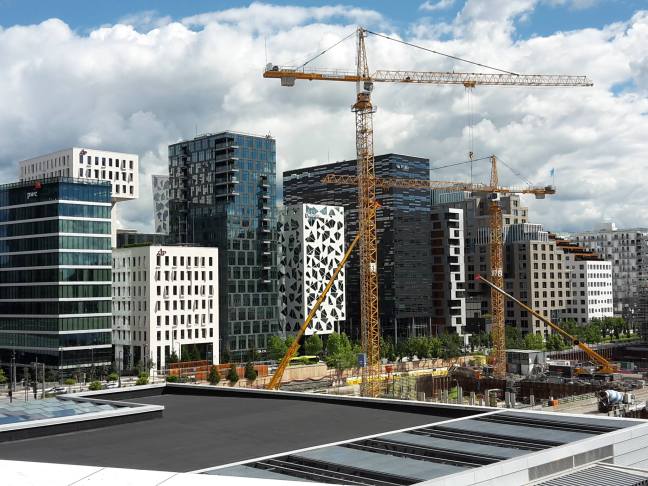
Oslo is re-inventing itself: the docks have been moved a little further out of the city centre, the semi-freeway roads along the port have been buried and the new opera house is the first of many buildings to be built in this area.

By 2020, the new Munch museum, the public library and other buildings will be finished. There are tens of cranes in this area alone. On the other side of the street are many new office and living buildings, known as “the barcode”.

New public access to the fjord has been opened, with a sandy beach, decks, an 8-lane 50m long pool (fjord water, currently at 17 degrees..), showers, restaurants, terraces, parks and apartments.
______________

Oslo est en pleine (r)évolution : les docks ont été déplacés hors du centre ville, les semi-autoroutes qui longeaient le port sont maintenant souterraines et l’opéra est le premier des nouveaux bâtiments qui vont être construits ici.

En 2020, le nouveau musée Munch, la bibliothèque et de nombreux autres immeubles seront terminés. Il y a des dizaines de grues dans ce secteur. De l’autre côté de la rue se trouve le quartier du “code barre” avec des logements et des bureaux.

De nouveaux accès au fjord ont été ouverts avec plage de sable, pontons, douches, piscine de 50m (eau du fjord à 17 en ce moment), restaurants, terrasses, parcs et appartements.

Trieste

After 48 hours in Venice, we spent a little under two days in the delightful city of Trieste.
The grand official buildings, large avenues and general architecture testify to its long central European history.
Many writers (James Joyce lived here for ten years, Italo Svevo was born here) and philosophers enjoyed its café culture. To this day, Triestinos are by far the biggest coffee drinkers in Italy.
We’ll be back.


Après 48 heures à Venise, nous avons passé un peu moins de deux jours dans la délicieuse ville de Trieste.
La grandeur de ses bâtiments, ses larges avenues et son architecture témoignent de son passé centre-européen.
De nombreux écrivains (James Joyce y a vécu dix ans, Italo Svevo y est né) et philosophes ont profité de ses cafés. Aujourd’hui encore, les Triestins sont, de loin, les plus gros consommateurs de café en Italie.
Nous y reviendrons.

Stopover in Venice

We are staying in the Cannaregio neighbourhood of Venice on our way to our next hike. This part of Venice is still quite local and relatively quiet.


Nous sommes à Venise, dans le quartier de Cannaregio, en route pour notre prochaine longue randonnée. Ce coin de Venise est encore habité par des Vénitiens et relativement tranquille.

Maastricht

We spent a rainy day visiting the pleasant little town of Maastricht, where many churches have been transformed in creative ways: a hotel (rooms are in the adjacent former convent), student cafeteria/workplace and a bookshop.

Nous avons passé une journée pluvieuse dans la jolie petite ville de Maastricht, où plusieurs églises ont été transformées de manière créative : un hôtel (les chambres se trouvent dans l’ancien couvent adjacent), une cafétéria/espace de travail pour étudiants et une librairie.

Traces of the past

Hotel New York, formerly the offices of the Holland-America line, warehouses with Indonesian (a former Dutch colony) islands names, undergoing renovations, old buildings get a new life.


Traces du passé

L’hôtel New York, qui occupe les anciens bureaux de la ligne Hollande-Amérique, des entrepôts aux noms d’îles indonésiennes (une ancienne colonie néerlandaise) en rénovation; les anciens bâtiments retrouvent une nouvelle vie.

SS Rotterdam

The SS Rotterdam was launched in 1958 by Queen Juliana of the Netherlands and crossed the Atlantic, for the Holland-America line, for the first time in 1959. It sailed in the Caribbean until 2000 (renamed Rembrandt), after transatlantic crossings came in disuse when flights became cheaper.

The ship is now permanently moored on the south side of the river Maas and works as a hotel. Its terrace, overlooking the city, and its vintage interior make it a popular spot for locals and tourists alike.


Le SS Rotterdam a été baptisé en 1958 par la reine Juliana des Pays-Bas, avant de traverser l’Atlantique pour la première fois en 1959, pour la Holland-America Line. Il a navigué dans les Caraïbes jusqu’en l’an 2000 ( sous le nom de Rembrandt) quand les prix des billets d’avion ont rendu les traversées en bateau obsolètes.

Le navire est à quai de manière permanente sur la rive sud de la Meuse et est devenu un hôtel. Sa terrasse, avec vue sur la ville et sa décoration vintage en font un lieu prisé des résidents comme des touristes.

Architectural styles, Lausanne

Lausanne has a variety of architectural styles : besides the many 19th and 20th century buildings, there is Bernese influence on Place de la Palud, including the fountain. A long-standing landmark of the city, the Bel-Air tower was built between 1929 and 1932 in a modernist American style. The Flon neighbourhood was renewed and boasts innovative buildings. The Polytechnical School (EPFL)’s campus is also the home to some modern buildings, among others the Rolex Learning Centre.
Lausanne will also see a green tower (Tour des Cèdres), putting the town higher on the world’s architectural destinations.
http://www.treehugger.com/…/another-vertical-forest-being-b…


Lausanne a de nombreux styles architecturaux, des bâtiments des 19 et 20e siècles à l’influence bernoise à la place de la Palud, en passant par le quartier rénové du Flon. La tour Bel-Air, construite entre 1929 et 1932 dans un style moderniste américain, est un des symboles de la ville. Le campus de l’EPFL (Ecole polytechnique fédérale) compte également quelques bâtiments intéressants, dont le Rolex Learning Centre).
Lausanne deviendra sans doute une destination architecturale prisée avec la construction de la “Tour des cèdres”.